
Showing posts with label Success Stories. Show all posts

Wednesday, May 30, 2012

Little League cardiac arrest highlights need for heart screenings


By Dr. Marc Siegel
Published May 29, 2012
FoxNews.com
Description: http://global.fncstatic.com/static/managed/img/fn2/video/052412_an_heartstop_640.jpg

Sean Neely, 12, was playing catcher at a little league game in Freeport, Pennsylvania earlier this month when he was hit in the chest with a foul ball. For almost anyone, this would be just a bruise. But for this boy, the thump to the chest came at exactly the most vulnerable moment in the cardiac cycle, sending his heart into a lethal arrhythmia; probably ventricular fibrillation, where the heart quivers and then stops.

The condition where trauma to the chest causes this to happen is known as commotio cordis. It is very rare, and only 15 percent of people who experience it survive. Luckily for Sean, his two coaches initiated Cardio Pulmonary Resuscitation right away (which preserves about 30 percent of cardiac output), and he came around. He was airlifted to Children's Hospital of Phil adelphia, a top notch facility where he was tested and observed for three days, and was reportedly found to have a normal heart. It was a medical miracle that he suffered no damage from the heart stoppage.

Most people who develop this problem require immediate defibrillation; where electric shocks are administered to the chest to restore a normal beat. There are laws to ensure that automated external defibrillators are available in all fifty states, and good Samaritan laws to protect those who use them. They are easy to use; you put the pads on the chest and the defibrillator does the rest - sensing the rhythm and administering a shock if needed. The American Heart Association estimates that AEDs could save 20,000 lives when they are used promptly.
 
Sean Neely wasn't one of those 20,000 -- the AED wasn't necessary in his case, though one was available on the scene. His heart rhythm returned to normal spontaneously, and the CPR preserved blood flow to Sean's brain and other vital organs until that happened.

Sean's unlucky cardiac arrest wasn't the result of an underlying problem with his heart. Pre-screening by a pediatrician or even a heart specialist could not have predicted this event. Nevertheless, any time a young person sustains a heart attack or arrhythmia while engaging in sports it is a good time to issue a reminder: All teens should see their pediatrician before competing.

I believe these teens should all have at least an EKG as well as a careful physical examination, with special attention paid to their heart sounds and abnormalities on the EKG which might predict an arrhythmia. Any heart murmurs should precipitate an echocardiogram of the heart to make sure there are no problems with the valves or walls of the heart. Any abnormality should immediately be discussed with a cardiologist.

Keep in mind that 100,000 young athletes die of cardiovascular events while participating in sports, which is more than those who die in car accidents. The most common cause is from hypertrophic cardiomyopathy, an abnormal thickening of the wall of the heart that is difficult to diagnose without an echocardiogram.
 
Sean was lucky; he owes a lot to his coaches and to the two nurses who were on the scene. Others aren't as fortunate - we need to keep a special eye out for heart problems as our teens engage in competitive sports. They are too precious to lose.

Marc Siegel MD is an associate professor of medicine and medical director of Doctor Radio at NYU Langone Medical Center. He is a member of the Fox News Medical A Team and author of The Inner Pulse; Unlocking the Secret Code of Sickness and Health.

Wednesday, April 18, 2012

Young batter hit by pitch in Colonie suffers rare heart stoppage, but quick response makes the difference

Teamwork proves vital as Little Leaguer revived

Young batter hit by pitch in Colonie suffers rare heart stoppage, but quick response makes the difference
Updated 09:43 p.m., Tuesday, April 17, 2012


The heart of an 11-year-old Little League baseball player started beating again Monday evening moments after he was hit by a pitch and nearly died at home plate.
The boy was batting in a Colonie Little League game at Cook Park when he was struck by a pitch and crumpled to the dirt. The pitch had hit him in the chest and stopped his heart.
A coach and police officer performed CPR before a defibrillator brought the boy back to life. He was recovering Tuesday at Albany Medical Center, police and coaches said.
"This was about everyone working together as a team," said Frank Prevratil, the president of Colonie Little League.
Prevratil, who also was the coach of the other team, was the first to begin CPR.
"There was no panic from anyone, no hysteria," Prevratil said. "Everyone did exactly what they were supposed to do."
Police and Colonie Little League officials declined to release the boy's name.
The boy may have suffered a condition called commotio cordis, which occurs when there is a blow to the heart at precisely the right fraction of a second to disrupt the organ's electric rhythms.
About 65 percent of commotio cordis victims die, though it accounts for only three or four deaths nationally each year, said Peter Berry, deputy chief of the Colonie EMS department.
"In my 23 years in the department, this is the first call for of this specific type of incident that I can recall," Berry said.
The call came into Colonie EMS dispatchers at 6:37 p.m. Monday, seconds after the boy had been hit, Berry said.
The boy's coach, Mike Martin, bolted from the dugout and realized the boy was having trouble breathing, Prevratil said.
Martin declined comment, other than to say the boy was doing well Tuesday.
When Prevratil saw the boy's coach needed further assistance, he rushed from his own dugout. On his way to home plate, he heard someone from the stands shout, "Call 911!"
While Martin and Prevratil tended to the boy, he slipped out of consciousness. That's when Prevratil began CPR.
He performed chest compressions for only about 30 seconds before Colonie police officer Brian Curran arrived on the scene, at 6:42 p.m., Colonie Police Lt. Robert Winn said.
Colonie Police declined to make Curran available for comment.
Curran took over CPR, but it was only two minutes before the EMT team reached the boy with a defibrillator.
His heart restarted while he still was lying in the batter's box, Prevratil said, and he was taken away by ambulance.
By that time, all the other players had been moved to another field, where they couldn't see what was happening at home plate.
"It was amazing to see everyone working so calmly," Prevratil said. "Everyone did what they were trained to do."
The umbrella Little League organization mandates that at least one coach of every team participate in a two-hour safety course, which covers everything from first aid to life-threatening incidents.
"I'm very proud of that training and the way it worked," Prevratil said.
In 2000, commotio cordis was responsible for the death of a 14-year-old lacrosse player from Long Island named Louis Acompora.
His death led to what is now called, "Louis's Law," which mandates all New York State public schools have defibrillators available at sporting events. But the law does not govern recreational leagues.
piorizzo@timesunion.com * 518-454-5425 * @PeteIorizzo


Read more: http://www.timesunion.com/local/article/Teamwork-proves-vital-as-Little-Leaguer-revived-3488642.php#ixzz1sOrl6jME

Monday, February 6, 2012

Updated 02/03/2012 09:32 PM

Lacrosse Player Hospitalized After Hit To The Chest

By: Casey J. Bortnick

A 12-year-old boy is in guarded condition at Strong Hospital after police say he was hit in the chest with a lacrosse ball during an indoor game in Gates Thursday night. Ambulance crews performed CPR and used a defibrillator to restart his heart. For hundreds of local lacrosse players and their families, it's a strong reminder of how important player safety is.
Lacrosse, at any level, is a game of speed and flexibility. That's why the equipment is lightweight and flexible.
"Football pads are used to deliver a blow, whereas these (pads) are used to protect the player from incidental contact,” said Tim Britton, youth lacrosse coach.
Britton and Scott Nitti coach youth lacrosse. They say safety comes first.
"You've got sticks coming down, balls flying through the air. You've got to make sure you're dressed properly for the game,” said Nitti.
Eleven-year-old Jake Jamieson isn't worried about safety, but his father Ralph is.
"We bought an upgraded helmet, made sure that was top of the line."
An ex-lacrosse player himself, Ralph says today's gear has come a long way.
"I think it's a lot better. I mean we had chintzy thin pads, thin shoulder pads, gloves didn't wear elbow pads."
Even the best gear isn't perfect.
Thursday night, around 6, emergency crews were called to the total sports experience in Gates.
"There was a 12-year-old patient who suffered a serious sports related injury,” said Randy Campbell of Gates Volunteer Ambulance.
A young lacrosse player was hit in the chest with a ball. When EMS crews arrived, an off-duty Rochester firefighter was already performing CPR. EMTs used a defibrillator to restart the boy's heart.
As he fights for his life, parents and coaches are taking a second look at what's protecting these players.
"I think the lacrosse community was greatly affected by what happened here last night,” said Britton.
Britton says some players on the JV and Varsity levels are tampering with their gear in the hopes of gaining a greater range of motion, leaving their shoulders and chest unprotected.
"We will be more conscious to alterations to equipment to make sure that's not the case,” said Britton.
"The heart has got to be protected and they've got to make sure these shoulder pads are snug around their waist area, so there's no room for the ball to enter into that area."
Ralph says you can't prevent a freak accident, but you can put a bigger emphasis on safety.
"You want to have fun, you want to all go home at the end of the night, you know, same way you came in that for sure,” Ralph said.
YNN is not releasing the name of the boy who was injured out of respect for the family.
The boy’s coach, Dan Merola, was clearly shaken over the incident. He's asking the community for prayers to help his player "pull through this."

Monday, October 10, 2011

Quick-thinking teachers revive girl, 12, after collapse

By Michael Inbar
TODAY.com contributor
updated 10/10/2011 9:53:01 AM ET

A Dallas-area seventh-grader survived a literally heart-stopping crisis virtually unscathed thanks to two quick-thinking, well-trained schoolteachers.

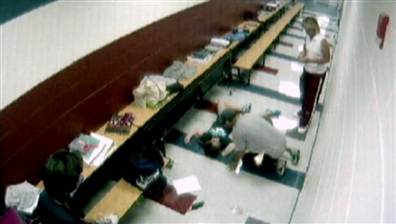
Kristen Goodgion and Brent Reese, teachers at Maus Middle School in Frisco, Texas, rushed within seconds to the aid of 12-year-old Kylee Shea after she crumpled in a school hallway Sept. 26. While Reese performed CPR, Goodgion fetched the school’s automatic external defibrillator (AED). They used the machine’s paddles to kick-start Kylee’s heart in a dramatic rescue caught on the school’s surveillance cameras.

Doctors estimate that without the rapid response of Goodgion and Reese and the use of the AED, Kylee would have had just a 3 percent chance of surviving her episode of heart arrhythmia, and only a 1 percent chance of surviving without brain damage.
Story: Meet ‘Lazarus tot’ whose heart stopped for 1 hour
Goodgion and Reese are now being hailed as heroes. Appearing on TODAY with Kylee and her family Monday, Goodgion told Matt Lauer she knows firsthand the benefits of the school having its teachers trained in CPR and use of the AED.
“(It’s) extremely important,” she said. “We get trained every two years, and that literally is what we fell back on. It kept us calm; we had something to (fall) back on, to know what to do.”

‘It told us to shock’
Kylee had no prior history of heart trouble, but was walking to class when she felt short of breath. “I sat down, then I fell over, and I don’t remember anything after that,” she told NBC’s Lilia Luciano.

Goodgion, nearby, was alerted by alarmed students. Within seconds, Kylee began convulsing and turning blue. “Right away, I knew I had to go get help,” Goodgion told NBC News.

Reese arrived on the scene just moments later. He told Lauer while Kylee’s heart had stopped, his was racing.

“When I saw Kylee on the floor, just a million things are going through (my) head,” he said. “You just kind of go into shell shock, and you kind of just reboot and we went back to the training.”

Surveillance video shows teacher Brent Reese
working to revive 12-year-old Kylee Shea,
collapsed on the the floor. Kristen Goodgion
stands at right.
As the video vividly shows, Goodgion arrived at Kylee’s side with the AED. While the teachers were trained in its use, actually deploying the paddles on a living subject was a new experience. They hooked the AED up to Kylee and it began reading her vital signs.

“It told us to shock, and we both looked at each other in shock, like, ‘This is really what we need to do right now?’ ” Goodgion recalled.

Reese was only too aware that if Kylee’s heart was actually still beating, the shock paddles could do just the opposite of their intent — kill her.

“In the video, I reach out to touch the (shock) button, and I pull back just a little bit, thinking those exact thoughts,” he told Lauer.

Nontheless, the pair shocked Kylee’s heart. After a second attempt, the procedure appeared to work, with the AED reading “no shock required.”

“She started groaning and we’re still thinking, ‘Did we do this right?’ ” Goodgion said. “(But) it worked.”

A 12-year-old with a pacemaker
Emergency personnel arrived and Kylee was airlifted to a local hospital. Doctors determined the 12-year-old had an undetected heart condition, and she was implanted with a pacemaker. She showed Lauer the scar from the procedure on TODAY.

Doctors told the family that if Goodgion and Reese hadn’t been trained and reacted as quickly as they did, Kylee would likely have been lost. And it was no less fortunate that the the state of Texas mandates that AEDs be placed in all state schools.

Grateful mom Sheryl Shea told Lauer she believes that rule should be universal.

“I think it should be a nationwide mandate,” she said. “I think every state should be required to have these in schools and public places.”


Goodgion and Reese say they now feel a special bond with Kylee — Reese jokes that Kylee, as she grows older, won’t be allowed to date without his permission.

Lauer suggested that every school should be required to have Reese and Goodgion as well an AED.

Kylee’s dad, Mike Shea, reached across to pat the hands of his daughter’s saviors. “They’re stuck with us, (but) thank you!”

© 2011 MSNBC Interactive.

Thursday, May 5, 2011

Coaches' Quick Action Saves Student

May 5, 2011 by JOIE TYRRELL / joie.tyrrell@newsday.com

Comsewogue High School coaches Rick Miekley and Justin Seifert had to act fast. One minute, 17-year-old Hope Reindl, a member of the school's softball team, was shooting hoops in an after-school intramural basketball game. The two coaches were supervising.

Moments later she was struggling to breathe after collapsing to the floor Wednesday afternoon in the school gym.

Miekley immediately came to her aid and Seifert had a student race to bring over a portable defibrillator. Together, they helped revive Hope and maybe even saved her life.

"I realized she was breathing, but labored," Miekley said. Soon she stopped breathing so he started CPR. The two coaches then attached the defibrillator to Hope and waited for it to give her a jolt.

"We were able to get her shocked, and get her heart shocked within about a minute," said Miekley, who also teaches health and physical education.

Meanwhile, Reindl's mother, Candace, having been alerted by another student, arrived within minutes at the school to help, said Carl Reindl, Hope's father.

Carl Reindl, of Port Jefferson Station, said his daughter was doing well Thursday night. She was speaking and eating, he said.

Apparently, doctors told the family Hope had suffered an arrhythmia though she had never had any symptoms of a problem. She is expected to have a defibrillator implanted Fridayand was listed in good condition Thursday night at Stony Brook University Medical Center.

"It's something else, they are pretty miraculous," Carl Reindl said of the two coaches. "They pretty much saved my daughter's life, along with my wife."

Both coaches are certified in CPR and defibrillator use and are recertified every year. Miekley also is a former athletic trainer for Stony Brook University and a former CPR instructor.

"They never hesitated," said high school Principal Joseph Coniglione of the two coaches. "It is always about the kids for them and when they saw that, it was as if it was one of their own."

Dennis Whittam, public information officer with the Terryville Fire Department, which is based out of Port Jefferson Station, confirmed that emergency medical technicians were on the scene at about 7:40 p.m. Wednesday.

"The AED [defibrillator] the schools have was utilized to revive the student," Whittam said. "When Terryville fire department EMTs got there on scene . . . they had shocked the patient with the AED and then Terryville took over CPR and did all the normal protocols that they follow and the patient was revived."

Wednesday, April 8, 2009

Nurses Save Life of Boy With Rare Sporting Injury

By Lela Garlington

Wednesday, April 8, 2009 - It was as if lightning had struck the baseball player in the chest and shorted his heart's electrical circuit, medical staff say.

Instead, a catcher throwing a ball to third base last weekend hit Kyle McCammon in the chest. The impact, which hit Kyle between the second and fourth rib, stopped his heart from beating.

Luckily for 12-year-old Kyle, who plays competitive baseball as a Southaven Panther, his mother is a nurse, and she and two other nurses ran to his aid.

The freakish incident happened at 5:35 p.m. Saturday during the Rumble on the River tournament between the Southaven Panthers and the Arkansas Rattlers at First Tennessee Fields in Cordova.

When his mother, Mary McCammon, rushed on the field, she saw that her son was still breathing, but it was shallow and labored. His eyes had glazed over and he couldn't respond.

Her husband, assistant coach David McCammon initially thought the breath had been knocked out of him -- a typical baseball injury. But Mary McCammon, a home health nurse, realized it was much more serious.

Taking her middle and index fingers she placed them against her son's neck: "I couldn't feel a pulse. It was like I was in a tunnel. It was just me and Kyle."

Another nurse and mom, Cyndi Herrington of Olive Branch tried the other side. She couldn't feel a pulse either.

Color was draining from Kyle's face. His lips were turning blue.

"I think we all said in unison, 'He's not breathing. We need to do CPR,'" the child's mother recalled.

That's when another nurse from the opposing team, Deanna Gilbert of Marked Tree, Ark., stepped in and offered to help. "I got this Mom," Gilbert told Mary McCammon.

Twenty compressions to the chest. A single breath. Twenty more compressions to the chest. Another breath.

For seven minutes, the two nurses did what they had been trained to do. Because of them, Kyle survived.

As tears streamed down her face that day, Herrington said all she could think about was, "I can't let this child die."

By the time the ambulance arrived, Kyle had regained consciousness. He stayed overnight at Le Bonheur Children's Medical Center, and Mary McCammon said doctors gave her son a clean bill of health.

Kyle was diagnosed with "commotio cordis," which means commotion or concussion of the heart.

"It's very rare," explained Dr. Barry Gilmore, Le Bonheur's medical director for Emergency Services. When it happens, it is often with boys playing sports -- particularly baseball. "We don't even see one a year. The overall survival rate is 15 percent," he said. "The ones who have immediate CPR or a defibrillator -- within the first one to three minutes -- survive."

From 1996 to 2007, just 188 cases have been reported to the U.S. Commotio Cordis Registry.

That is why the Southaven Panther coaches are now getting CPR training.

Kyle remembers being hit and trying to get up but nothing after that.

His mother is hoping her son's brush with death will convince others to get cardiopulmonary resuscitation or CPR training. Even better, she said, "These defibrillators are under $1,000. They should be really anywhere people are.

"Never in a million years would you think a ball would stop his heart. But it did," Mary McCammon said. "Those nurses saved his life."

© 2009 Scripps Newspaper Group - Online

Tuesday, April 1, 2008

Gibbons Lacrosse Player's Life Saved by Defibrillator

By Nick Stevens

Raleigh, N.C. — Alex Beuris, a senior lacrosse player at Cardinal Gibbons, suffered a heart-stopping injury on Saturday morning, and if it weren't for the quick action and a machine called an Automated External Defibrillator, he might not be alive today.

Beuris was hit in the chest with the ball after a Providence Day player took a shot during the game.

“When it first happened, I didn’t know what happened ... I didn’t want to be one of those parents to run out on the field and go all crazy," Alex's mother, Sharon, told WRAL on Monday.

The blow caused his heart to stop beating and Alex stopped breathing.

"He started having a seizure, so I knew something wasn't right," his mother said. "When I got out there, he looked blue."

Sharon Beuris and Alex's 12-year-old sister were in attendance, but his father, Greg, was at a business conference in Daytona Beach, Fla. He said he received the call around 12:40 that afternoon, just after his airplane landed.

"We were just so fortunate that, for one, there were medical professionals in the bleachers, two or three from the other team," Greg Beuris said. “Sharron and I are just so thankful that they were there, the defibrillator was there, and it all was done in the right way.”

The medical professionals, spectators at the game, used a combination of an AED and CPR to jump start Alex's heart, and ultimately, prevent him from dying.

“There’s no doubt in my mind that his heart stopped, he stopped breathing, and if not for them it would be a much different situation," his father said.

Alex was rushed to WakeMed Hospital on Saturday afternoon, and the family returned home, with their son on Monday afternoon.

The Providence Day player that delivered the heart-stopping shot was playing within the rules, according to the Beuris family. "He took a good shot," Sharon Beuris said.

The father of the Providence Day player went to the emergency room at WakeMed to check on Alex's condition.

"I can't say enough about the support we've gotten from people we know, members of the team, and people we don't really know that well," Greg Beuris said. "It just makes you feel good about people."

Gibbons principal Jason Curtis said the defibrillator used was one that Gibbons has on its campus. The machines can cost in the thousands of dollars, and the prices can scare away some potential buyers.

WakeMed purchased AEDs for each middle and high school in Wake County in November 2003, and Wake County Senior Director for Athletics Bobby Guthrie said some high schools now have more than one AED.

Ravenscroft has eight AEDs on its campus, including one that travels around with their athletic trainer.

Alex was familiar with the AED that the lacrosse team carried with them before the incident happened on Saturday.

"He was the only freshman to make the team," his mother said, reflecting back to his freshman year at Gibbons, "and his job was to bring the AED with him."

Alex is a senior at Cardinal Gibbons this year, and was named first-team All-State in 2007 for men's lacrosse as a defender The family said Alex is at home and doing well.

The game between Cardinal Gibbons and Providence Day was suspended in the fourth quarter with Cardinal Gibbons leading 5-3.

Copyright 2008 by WRAL.com. All rights reserved.

Thursday, February 28, 2008

Several Rush From Stands to Help Injured Lacrosse Player

To watch a video news report on this story click here.

NEPTUNE BEACH, Fla.
- A Fletcher High School lacrosse player remained hospitalized Thursday afternoon, a day several heroes emerged from the sidelines to help him during some scary moments on the field.

Wednesday's game between Fletcher and the Bolles School changed in an instant when goalie James Hendrick stopped an attempted goal.

Witnesses said Hendrick collapsed on the field after being hit by a ball. According to fire and rescue, the teenager went into cardiac arrest from the blow to his chest.

He stopped the shot. It hit him in the chest, and initially I thought it knocked the wind out of him," said Athletic Director Joe Reynolds.

Eva McAllister, an athletic director for the team, was among those who saw what happened and rushed on the field to help the player.

"I looked back and the goalie was on the ground. At that point we go out and check on him. I thought it was maybe his knee and the position he was in, but when I got out there realized very quickly it was much more than that," McAllister said. "We realized he wasn't breathing very well, and then he quit breathing. We went and got the defibrillator we have the school. At that time we began doing CPR."

"The coach got to him pretty fast, but he did eventually go into cardiac arrest," Reynolds said.

Hendrick was flown by air ambulance to Shands-Jacksonville Medical Center. Channel 4 was told that without the help of some fans who were in the stands, Hendrick might not have made it to the hospital.

"We were definitely very lucky. It was the right place and the right time," McAllister said.

"I'll tell you what, they're the heroes, and I really believe they saved James' live," Reynolds said.

Although Hendrick won't be on the lacrosse field any time soon, Reynolds said he believes the injured goalie will be OK.

Copyright 2008 by News4Jax.com. All rights reserved.

Tuesday, December 18, 2007

Ref Owes His Life to Quick Thinking Teen

By Dana Thiede, KARE 11 News

[Click here to watch The CNN Video]

49 year old Dale Wakasugi loves the challenge of refereeing high school basketball games; getting calls right, by making decisions in a split second.

Last Thursday at Fridley High School, it was a spectator who made one of those quick decisions, and Wakasugi is alive because of it.

16-year-old Lindsey Paradise and her mom were watching the contest between Fridley and Simley when they noticed one of the officials stumble and fall to the court.

It was Wakasugi, who had suffered a serious heart attack.

Paradise jumped to her feet and ran onto the court, armed with recent CPR and Automated External Defibrillator training she had recieved in health class.

"It's crazy," laughed Lindsey's twin sister Alyssa, who looked on as a Fridley cheerleader.
"At first when I saw her run down there, I'm like, get out of there, but then I realized, oh, she knows what she's doin, she can do it."

Lindsey's health teacher, Jim MacDonald, agreed. "She just has, we call em 'star qualities," he said. "She just went out there, looked at the situation, and just put the situation in front of her."

Paradise was soon joined by two nurses who were in the crowd, and another adult samaritan. They administered CPR, but after three rounds, Lindsey still found no pulse. Lindsay then sent someone to get one of the school's A-E-D machines, followed the recorded voice instructions, and then pressed the button. "I'm like, I know what happened in class, I wonder what's gonna happen now," she recalled, "so I pushed it, it shocked him, I'm like oh my gosh, it's amazing, it actually worked."

Wakasugi's heart started to beat on it's own. He was rushed to the hospital, where a stent was implanted in his heart. He was discharged this afternoon, just four days after the attack. Dale is anxious to resume refereeing, and 'more' anxious to meet the 16-year-old who saved his life. "God sent her to be at that place, at that time, for a reason," he reasoned. "So many things had to happen for me to be alive, and they all fell into place."

Thursday, March 29, 2007

Trinity Player's Dad: 'A Miracle' Son's Alive

"It wasn't looking good" for lacrosse player struck in chest, father says.

By MICHAEL CARVELL
The Atlanta Journal-Constitution
Published on: 03/29/07

Blessed Trinity lacrosse player Matt Ivie, who suffered a life-threatening injury when he was struck by the ball in the chest during a March 16 match, said he plans to return to sport this season.

School officials have declined to speak on the incident, but David Ivie, the player's father said he thought "had lost his son for a minute or two" after he was struck in the heart area from a ball hurled from around five feet away traveling as fast as 80 mph.

"I really thought he was maybe slipping away," the elder Ivie said.

"He was motionless, he wasn't breathing, and the trainer said his pulse was getting weaker and weaker. His eyes were open, but the pupils weren't moving. He had blood coming out of his mouth and nose.

"It wasn't looking good, that's for sure."

Ivie said Blessed Trinity trainer Preston Bazemore had cut off his son's uniform, and hooked up electrodes from the defibrillator across the chest area. Fortunately, the shock treatment was not needed because the player somehow regained consciousness.

"Matt blinked, and then he coughed, as if he was under water for a long time. Then he took a deep, deep breath. It was a miracle."

When a lacrosse ball, baseball, hockey puck, softball strikes a player near the heart area at a precise moment between beats, it can cause contractions that lead to rare from of death called "commotio cordis." According to U.S. Commotio Cordis Registry, more than 130 cases had been reported by 2001.

The elder Ivie said while doctors say his son's life was "in danger," they don't believe he experienced commotio cordis because only the use of a defibrillator can restart the heart, and Blessed Trinity's defibrillator was hooked up but never used. He said the doctors were reviewing the readings from the machine, but may never know exactly what happened.

Matt, 16, said the only thing he remembers is falling to the ground after the ball deflected off his body in Roswell private school's match against McIntosh, which was immediately canceled after the incident. Ivie was transferred to Scottish Rite hospital, where he said he was diagnosed with bruised heart and lung and remained under observation for two days.

"It was a freak accident, but it made me think about what I am doing with my life, and how I should change it around because you never know if today will be your last day," Matt said. "I feel lucky to be alive, and I am so thankful to Mr. Bazemore."

Matt said his chest area remains sore, but that doctors told him he suffered no permanent damage and could be given clearance to return to lacrosse by the second week of April. His parents have purchased a pair of shoulder pads that are longer in front, providing more protection for the chest area.

"We decided we wanted to tell Matt's story because we want to get the word out about this [danger]," the elder Ivie said.

"Even though there may be only one chance in a million of this happening, there's still a chance. Fortunately, Blessed Trinity had the right people and right equipment when it happened. They invested in those resources for the safety of our children.

"There may be other schools out there that don't think they need these resources at lacrosse matches or other events, but hearing about this may convince them otherwise, to make it more of a priority."

© 2007 The Atlanta Journal-Constitution

Tuesday, February 27, 2007

Quick Thinking Saves a Life at Wrestling Match

New York Teacher - February 27, 2007 -

Shane Lese has spent years acting on the "let's get physical" buzz. It's his job, as a phys ed teacher and wrestling coach at Horseheads High.

In December, his physical response was tested when he used an Automated External Defibrillator to help save a man who was having a heart attack at a wrestling match.

Lese, a member of the Horseheads Teachers Association in the Southern Tier, was coaching a match at Newark Valley High.

"I'd gone into the cafeteria to get a quick bite to eat and was coming back," said Lese. "I was just on my way back to the gym and I noticed a commotion."

That's when he was told a man in the bleachers was having a heart attack. He and a group of helpers put the man, John Lupo, flat on his back in the bleachers.

"We all kind of helped in the process of getting him to lie down," said Lese. "Then he became unresponsive."

Donna Hyde, a registered nurse and mother of a wrestler, and Lese both said, "We need to get a hold of an AED," Lese recalled.

Hyde and Walter Farrell, father of a wrestler, took Lupo's pulse.

"We determined he didn't have a pulse. He was not breathing," said Lese.

He said it only took about a minute for wrestling coach Eric Darcy, a member of Newark Valley United Teachers, to locate and hand them a defibrillator. The life-saving devices are now required in every school because of a NYSUT-backed state law that took effect in 2002.

Hyde started chest compressions and Farrell was doing rescue breaths, said Lese, who is a certified CPR instructor.

With the commotion in the gymnasium as people were cleared out, Lese said, it was hard to hear the AED prompts.

Shutting down

"It was a scary moment to see a man who, when you looked at him, was gasping for air. His body was shutting down," Lese said.

"You didn't know what he was feeling other than that something was desperately wrong."

He gave Lupo one shock with the AED and was relieved to see him become "somewhat responsive."

"Right as the EMTs arrived, he was just starting to come to," Lese said. "His heart hadn't completely stopped."

AEDs, he said, deliver a shock to get the heart into a more natural rhythm. "To not have these at different facilities is kind of crazy," Lese said. "Seeing CPR administered to what was a lifeless body … it's scary ... you're just thinking, 'What do we have to do?' You do what you're trained to do."

Lese said he is not a hero.

"A hero risks their life," he said. "I was just in the right spot at the right time."

At Horseheads High, all high school students are taught adult CPR.

NYSUT.org. Copyright New York State United Teachers. 800 Troy-Schenectady Road, Latham, New York, 12110-2455. 518.213.6000. http://www.nysut.org.

Thursday, April 27, 2006

'True Miracle' Saves Driver's Life

April 27, 2006

Mary Blome and Steve Earle join Carolyn Holt
to talk about "miracle" life-saving
(CBS/The Early Show)
"The first thing I remember is waking up in
the intensive care unit of the hospital and
people saying to me, 'what do you remember?'
 And I said, 'Nothing.'"
...Carolyn Holt
[Click here to watch "The Early Show" (CBS) interview]

(CBS) Luck was on the side of a Missouri woman who went into cardiac arrest while driving.

Carolyn Holt was alone in her car on Friday, driving in St. Charles, Mo., when her heart stopped beating. She drifted across several lanes of traffic and then crashed into a guard rail. Other drivers stopped to help and by sheer luck, two of them were nurses and one was a defibrillator salesman — who happened to have a defibrillator in his car.

A truck driver used his trailer hitch to smash through a window and pull Holt out of the car. The nurses performed CPR and then used the defibrillator to shock Holt back to life. She spent the week in the hospital and is expected to be released April 27.

Holt joined two of her good Samaritans, Mary Blome, the nurse, and Steve Earle, the salesman, for an interview with The Early Show Thursday morning. She told co-anchor Julie Chen she has no memory of those terrifying moments on the road.

"Everybody finds it hard to believe, but the first thing I remember is waking up in the intensive care unit of the hospital and people saying to me, 'what do you remember?' And I said, 'Nothing,'" Holt told Chen. "So they started telling me the story about my very helpful friends."

Earle, who was driving with his wife to pick up their daughter, described the moment when he realized someone was in trouble. "We basically saw traffic slowing down, and Carolyn's car coming across the center line very, very slowly," he said. "At that point when I sort of swerved to go around her, I looked over and realized there was definitely something wrong. She looked to be unconscious at the wheel, and that's when we, along with several other cars, pulled over, and went over to see what was wrong."

Blome is a registered nurse and she jumped into action. "We went over to knock on the window. We thought this was just a small vehicle accident, and realized that Carolyn wasn't responsive. So the other man that is not with us today smashed in the window of the vehicle, and the gentleman got Carolyn out, and the other nurse and I assessed her and realized that she was in big trouble and we started CPR, compressions and breathing," she said. "Then Steve came with the defibrillator. It was a true miracle that evening."

As a salesman, Earle says he always carries defibrillators in his car — but it was unusual to be in his car at that point during the day. "It was strange luck that day because when we finish up work for the day, a lot of times we'll get in my wife's car and take it out to eat or to pick my daughter up. We just happened to get into my car for some reason."

Holt was full of thanks for her saviors and said, considering the amazing luck she's had, she might just buy a lottery ticket when she's released from the hospital.

©MMVI, CBS Broadcasting Inc. All Rights Reserved.

Friday, February 17, 2006

Machebeuf JV Coach Collapses at Game

By Neil H. Devlin
Denver Post Staff Writer

Cherry Hills Village - (2/17/2006) Tom Young, the junior varsity boys basketball coach at Bishop Machebeuf, suffered what appeared to be a massive heart attack Thursday while his team was playing at Kent Denver.

He was taken to Swedish Medical Center, where a spokesman said he was in serious condition. Julie Lonborg also said doctors were attempting to confirm the reason for Young's collapse. Kent Denver varsity coach Todd Schayes visited Young late Thursday and said he was alert.

Young collapsed on the Buffaloes' sideline with 4:23 remaining in the fourth quarter and his team trailing 40-30. It devastated the players, coaches, fans and officials at Kent Denver's Black Field House, some of whom immediately rushed to Young's aid.

A plea for a doctor was answered through happenstance by Jonathan Branch, the father of Bishop Machebeuf varsity player Nick Branch, and a male nurse at Walter Reed Hospital in Washington, D.C., who recently traveled to Colorado to watch his son compete.

The elder Branch performed CPR and used a portable defibrillator that helped to revive Young. After several anxious moments, local EMTs arrived and took Young by ambulance to Swedish.

Jonathan Branch, who received thanks from several crowd members for his quick action, said Young "probably suffered a heart attack."

Through Lonborg, Young's wife, Joanne, said, "I'm terribly grateful for everyone's help."

Fans prayed out loud while Young was being treated, and Buffaloes players, many of whom refused to go to the locker room, were cheering for their coach to come out of it.

"I'm extremely proud of the kids and fans who witnessed this and handled it," Kent Denver athletic director Scott Yates said.

The rest of the junior varsity game was canceled. A decision on the postponed varsity game, which was to be the Class 3A Metropolitan League finale of the 2005-06 season, may be made today, Yates said.

All contents Copyright 2006 The Denver Post or other copyright holders.
Facebook
Twitter
You Tube
PO Box 767
Northport, NY 11768
Phone: 631-754-1091
iHealthSpot